

Lemon Poppyseed Muffins with Bakery-Perfect Crackled Tops
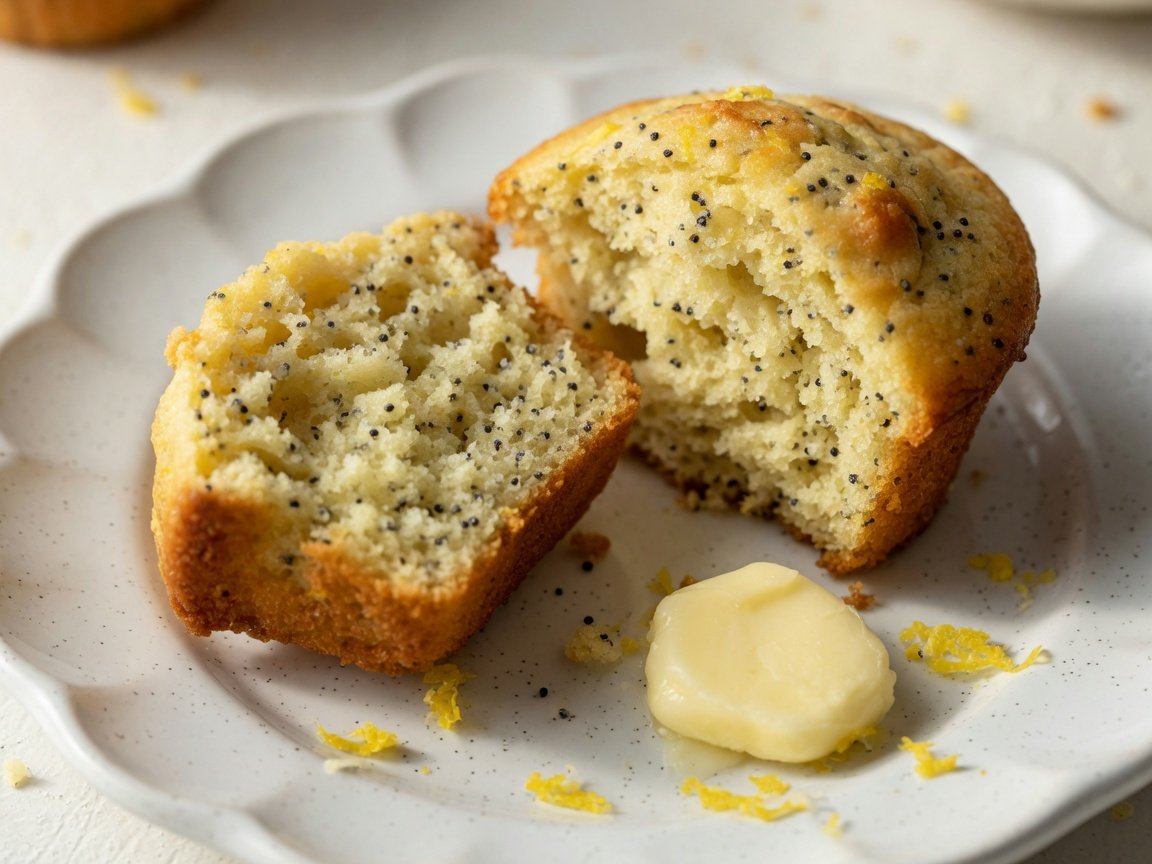
These are the lemon poppyseed muffins I’ve been chasing for years — the kind with that gorgeous crackled golden dome, a crumb so tender it practically sighs when you pull it apart, and enough lemon zing to wake up the whole kitchen. No fancy equipment, no complicated technique: just a handful of tricks that make all the difference between “pretty good” and “could have come from a proper bakery.”
Why These Muffins Are Worth Making
Here’s what sets these apart from a standard box-mix situation: a combination of vegetable oil and melted butter. The oil keeps the crumb moist for days; the butter brings the flavour. Add a full cup of sour cream and you get that soft, almost cakey texture that proper bakery muffins have — firm enough to hold together, tender enough to melt on your tongue.
The lemon flavour comes from two sources: fresh juice for brightness and tang, and plenty of zest for that floral, aromatic depth you can’t get from a bottle. I always use two whole lemons, because one is never quite enough. If you love baking with lemon, the same punchy citrus spirit runs right through my lemon crumb cake — another keeper for the weekend repertoire.
The crackled top? That’s down to two things: coarse sugar sprinkled on just before the oven, and a hot oven that you absolutely do not open for the first 18 minutes. Steady heat drives the batter upward before it sets, producing that signature dome. Interrupt it and you’ll get flat tops — still delicious, but not the bakery look we’re going for.
The history of lemon poppyseed as a combination is rooted in Central European baking — Austria and Germany in particular, where poppyseeds have been a pantry staple for centuries. The pairing made its way into American bakeries in the late 20th century, and it’s been a café fixture ever since. Something about the mild nuttiness of the seeds and the acidity of lemon just works perfectly together.
Ingredients
Equipment
How to Make Lemon Poppyseed Muffins
Click or tap each step number to mark it complete as you go. The progress bar updates automatically.
-
1Preheat oven and prepare your tin ⏱ 5 min
Heat your oven to 375°F (190°C). Line all 12 cups of your muffin tin with paper liners — don’t skip this even on a nonstick pan, since the liners help the muffins hold their shape as they cool. If your eggs, sour cream, or butter are still cold, this is your last chance to warm them up quickly. Set them in a bowl of warm (not hot) water for 5 minutes.
An oven thermometer is worth the small investment. Many home ovens run 15–25°F hotter or cooler than the dial suggests. The right temperature is what gives you that domed, crackled top. -
2Whisk all dry ingredients together ⏱ 3 min
In your largest bowl, whisk together the flour, poppyseeds, baking powder, baking soda, and salt until the poppyseeds are evenly distributed and there are no visible clumps of leavening. Proper blending here means the rise will be even across all 12 muffins.
Spoon flour into your measuring cup and level it off — don’t scoop directly from the bag, which packs the flour and can add up to 30% more, leading to dense muffins. -
3Combine all wet ingredients ⏱ 4 min
In your second bowl, whisk together the sugar, eggs, vegetable oil, melted butter, sour cream, lemon juice, lemon zest, and vanilla extract until everything is smooth and uniform. The mixture will look slightly thick — that’s the sour cream doing its job. Make sure no streaks of unincorporated egg are visible. The same barely-mixed technique that makes my bakery-style chocolate chip muffins work so well applies here — get the wet ingredients fully combined before they meet the dry.
Zest your lemons before you juice them — it’s nearly impossible the other way around. A Microplane gives you finely grated zest with maximum flavour and no bitter white pith. -
4Fold wet into dry — gently ⏱ 2 min
Pour the wet mixture into the dry ingredients all at once. Using a rubber spatula, fold together with 10–12 slow, sweeping strokes. Stop the moment you can no longer see dry streaks of flour. The batter should look lumpy — that’s exactly right. Overmixing develops gluten and turns beautiful muffins into dense little cakes. Resist the urge to smooth everything out.
If you see a few streaks of flour, that’s still fine — they’ll bake out. It’s far better to under-mix by two strokes than to over-mix by one. -
5Fill the cups and top with coarse sugar ⏱ 4 min
Divide the batter evenly among the 12 lined cups, filling each about ¾ full. An ice cream scoop makes quick, even work of this. If using coarse sugar, sprinkle a generous pinch over each muffin — this is the move that gives them that authentic bakery crackle and a satisfying crunch on top. Don’t be shy with it.
Filling the cups generously (¾ full) is what produces those beautiful domed tops. Under-filling leads to flat, sunken muffins. If you have a little batter left, bake it in a ramekin. -
6Bake, then cool in the pan ⏱ 23 min
Slide the tin into the centre of your preheated oven and do not open the door for at least 18 minutes. The domes need uninterrupted heat to rise and set. After 18 minutes, check: the tops should be golden brown and spring back when pressed gently in the centre. If they leave an indent, give them 2 more minutes. Cool in the pan for exactly 5 minutes, then lift them out to a wire rack. The bottoms need that brief rest to firm up, but leaving them longer makes them steam and soften.
A toothpick inserted in the centre should come out with just a few moist crumbs — not wet batter. Overbaked muffins are dry; trust the spring-back test over the clock.
Kitchen Timers
Start each timer when you reach that stage in the recipe. Browser notifications will alert you when time is up (you’ll be asked for permission once).
Gather & mix ingredients
375°F — don’t open the door
Then transfer to wire rack
Nutrition Information
Per muffin (1 of 12), including optional coarse sugar topping. Values are estimates.
| Nutrient | Per muffin | % Daily Value* |
|---|---|---|
| Calories | 285 kcal | |
| Total Fat | 13g | 17% |
| — Saturated Fat | 5g | 25% |
| Cholesterol | 50mg | 17% |
| Sodium | 220mg | 10% |
| Total Carbohydrates | 38g | 14% |
| — Dietary Fiber | 1g | 4% |
| — Total Sugars | 18g | — |
| Protein | 4g | 8% |
| Vitamin C | ~4mg | 4% |
| Calcium | ~80mg | 6% |
*Percent Daily Values based on a 2,000 calorie diet.
At a glance
Recipe Variations
Same base recipe, different directions. Use the tabs to explore.
Classic Lemon Poppyseed
Exactly as written above — crackled coarse-sugar tops, bold lemon, tender sour-cream crumb. This is the version I make on repeat. If you’re a dedicated lemon fan, the same bright citrus spirit carries right through to my pistachio lemon loaf, which makes a beautiful companion bake for a weekend spread.
Best served slightly warm, within a few hours of baking. Keeps 3 days at room temperature in an airtight container.
Lemon Glazed
Skip the coarse sugar topping. Once the muffins have cooled completely on the wire rack, drizzle a simple lemon glaze over each one.
Lemon glaze: whisk 1 cup (120g) powdered sugar with 2–3 tablespoons fresh lemon juice and ½ teaspoon lemon zest until you get a thick but pourable consistency. Drizzle over cooled muffins and allow to set for 10–15 minutes.
The glaze adds a sweet-tart shell that shatters as you bite through — particularly good the day they’re made.
Dairy-Free Version
Make these swaps and the texture barely changes:
- Replace butter with the same volume of additional vegetable oil (or use vegan butter, melted)
- Replace sour cream with full-fat coconut yogurt or a thick dairy-free plain yogurt — avoid anything runny
The crumb will be very slightly less rich, but still tender and moist. The lemon flavour comes through just as strongly.
Gluten-Free Version
Swap the all-purpose flour 1:1 for a quality gluten-free flour blend that contains xanthan gum (Bob’s Red Mill 1-to-1 Baking Flour and King Arthur Measure for Measure are both reliable). All other ingredients stay the same.
The batter will be slightly thicker — that’s normal. Don’t be tempted to thin it. The baked muffins will be a touch denser than the original but still have a good crumb and excellent flavour. Let them cool fully before eating; GF baked goods always improve as they cool.
Baker’s Tips for Perfect Muffins
Cold ingredients don’t emulsify properly. Pull your eggs, sour cream, and butter out at least 45 minutes before you start. The batter will mix more smoothly and rise more evenly.
One lemon gives you a background whisper of citrus. Two lemons gives you proper lemon muffins. Both the juice and the zest are doing separate, important jobs — don’t skimp on either.
Lumps in muffin batter are a feature, not a flaw. Every extra stir develops more gluten, which makes the crumb tighter and tougher. When you think it needs two more strokes, walk away.
Those first 18 minutes of steady heat are when the dome forms and sets. An early rush of cold air collapses the structure before it’s firm. Set your timer and step away from the oven.
If you want that signature crackled crust, the coarse sugar is what makes it happen. It melts and re-solidifies on the surface during baking, forming a thin, shatter-glass layer. Turbinado works best.
Most home ovens are 10–25°F off their dials. A correct temperature is more important than almost anything else in this recipe. A $10 oven thermometer prevents the most common muffin disasters.
Troubleshooting Common Problems
Storage & Make-Ahead
In an airtight container. Place a sheet of paper towel under and over the muffins to absorb moisture and keep the tops from going soggy.
Wrap individually or store in an airtight container. Warm for 15–20 seconds in the microwave before eating to revive the texture.
Wrap each muffin tightly in plastic wrap, then place in a zip-seal bag. Thaw overnight at room temperature or warm from frozen at 300°F for 12 minutes.
Frequently Asked Questions
Please don’t. Bottled lemon juice has a flat, slightly bitter, processed flavour that broadcasts itself clearly in a baked good. Fresh lemon juice is bright and clean, and the zest — which is the real flavour driver — can’t be faked at all. If you truly have no fresh lemons, use fresh lime juice instead and adjust the zest accordingly. A lemon-lime hybrid is far better than bottled lemon.
Yes — full-fat Greek yogurt is the best substitute, used in the exact same amount (1 cup). The fat content of full-fat yogurt is close enough to sour cream that the crumb comes out nearly identical. Low-fat or non-fat yogurt produces a noticeably drier muffin, so if that’s all you have, add an extra tablespoon of oil to compensate.
Three things working together: a correctly hot oven (375°F — verify with a thermometer), cups filled ¾ full so the batter has enough mass to dome, and coarse or turbinado sugar on top before baking. The sugar melts as the muffin rises and re-solidifies into a thin crystalline crust as it cools. The fourth essential — don’t open the oven door during baking. Cold air at the wrong moment deflates the structure before it sets.
Beautifully, yes. Let them cool completely first, then wrap each muffin individually in a layer of plastic wrap and transfer them to a zip-seal freezer bag. They keep well for up to 3 months. To reheat: unwrap and warm from frozen in a 300°F oven for 10–12 minutes, or microwave for 30–40 seconds. The crackled top softens in the microwave but comes back with a minute in the oven.
Usually one of four culprits: expired baking powder or soda (test by dropping baking powder in hot water — if it doesn’t bubble vigorously, replace it), the oven door was opened before 18 minutes, the oven temperature is too low, or the batter was overmixed. Overmixing creates a tight crumb that can’t support itself as it rises and then collapses when cooling.
Yes — this batter makes about 36 mini muffins. Use a mini muffin tin with liners, fill ¾ full, and bake at the same temperature (375°F) for 10–13 minutes. Start checking at 10 minutes. Mini muffins bake faster than standard ones; they’re done when the tops are golden and spring back to a gentle press.
Your Notes
Record your tweaks, swaps, or reminders for next time. Notes are saved locally in your browser.