
Clootie Dumpling
Scotland’s most-loved pudding — dense, warmly spiced, and stuffed with dried fruit, boiled in a cloth until beautifully dark and deeply satisfying.
What Makes Clootie Dumpling So Irresistible?
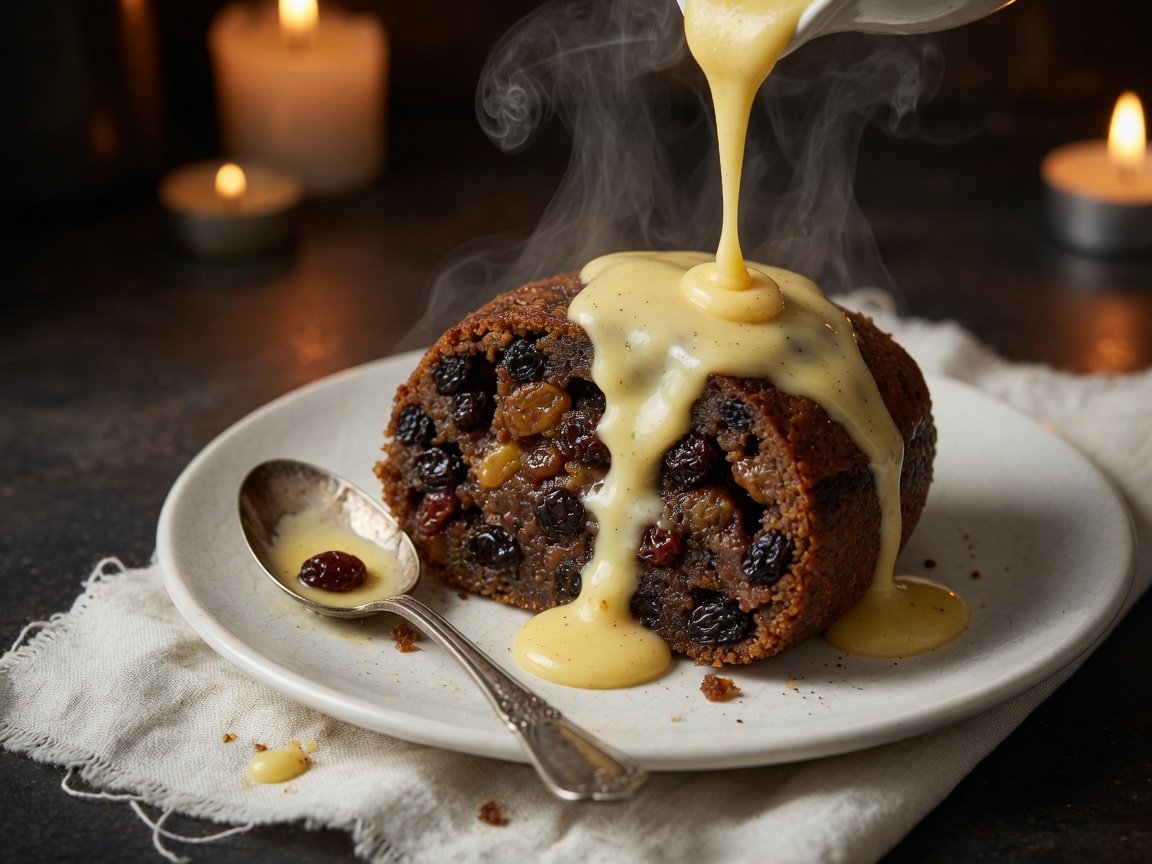
If you’ve never made a Clootie Dumpling before, get ready for one of the most satisfying moments in Scottish home cooking. You mix up a modest, humble dough. You tie it inside a square of cloth. You lower it into a pot of water and walk away. About three and a half hours later you lift out something that looks almost alive — a dark, glistening ball that you peel open to reveal a dense, fruit-studded interior warm with cinnamon, ginger, and mixed spice. The whole kitchen smells extraordinary.
This is proper comfort food. The kind that generations of Scottish families have put on the table for Christmas, for Hogmanay, for birthdays, and for ordinary Tuesday evenings when the weather outside is being rude. There’s something almost meditative about making it — the long, gentle simmer gives you time to potter around, and then the reveal moment when you peel back the cloth is genuinely exciting every single time.
🏴 A Little Scottish History
The word cloot is simply Scots for cloth — so a Clootie Dumpling is, quite literally, a cloth dumpling. The technique is ancient: before pudding basins and cake tins were common in Scottish kitchens, a square of cloth was all you needed to shape a pudding for boiling. The recipe dates back several centuries and was a staple of Scottish households long before it became associated with Christmas and Hogmanay (Scottish New Year’s Eve).
The old tradition of hiding coins and charms inside the mixture is still practised in many families today. Whoever finds one in their slice gets a wish — or at least a very good story to tell. And the beloved custom of frying leftover slices in butter for breakfast the next morning? That’s known in some parts of Scotland as hot peat, for its resemblance to a slab of dried peat. It is, frankly, one of life’s underrated pleasures.
Ingredients
Main Ingredients
- 225g plain flour, plus extra for dusting
- 225g fresh breadcrumbs
- 225g vegetable suet
- 225g mixed dried fruit — raisins, sultanas, currants
- 115g caster sugar
- 1 tbsp mixed spice
- 1 tsp ground cinnamon
- ½ tsp ground ginger
- ¼ tsp grated nutmeg
- 1 tsp baking powder
- 2 large eggs
- 300ml whole milk
For the Cloth
- 1 square of muslin or cheesecloth, approx. 60 × 60 cm (24 × 24 in)
- Kitchen string or twine
Equipment You’ll Need
Step-by-Step Method
0 of 5 steps completed
Tap a step to mark it complete. Tap again to unmark.
-
⏱ ~5 min
Prepare the cloth. Lower your muslin or cheesecloth into a pan of boiling water. Leave for 1–2 minutes, then lift out carefully with tongs and wring out firmly — it should be hot and damp but not dripping. Lay it flat on a clean surface and dust the entire surface generously with plain flour. This floured layer is the whole secret to the traditional outer skin.
-
⏱ ~10 min
Make the mixture. In a large bowl, combine the flour, breadcrumbs, suet, dried fruit, sugar, mixed spice, cinnamon, ginger, nutmeg, and baking powder. Stir well until everything is evenly mixed. Beat the eggs with the milk in a separate jug, then pour it gradually into the dry mixture, stirring as you go. Mix until you have a soft, sticky dough — it should just hold its shape. If it feels too wet, add a tablespoon of flour.
-
⏱ ~5 min
Wrap in the cloot. Lay the floured cloth inside a large bowl or colander so it holds its shape while you work. Spoon the mixture into the centre — it’ll sit like a generous soft ball. Draw the edges of the cloth up around it and gather at the top. Tie firmly with kitchen string, but make sure to leave a good 3–4 cm of slack — the dumpling expands significantly during cooking and needs room to breathe.
-
⏱ 3–3½ hr
Simmer gently. Place a heatproof plate or saucer in the bottom of your largest pot — this stops the dumpling sitting on the base and scorching. Lower the wrapped dumpling onto the plate. Pour over enough boiling water to completely submerge it, then put the lid on. Bring to a gentle, steady simmer and keep it there for 3 to 3½ hours. Check every 30–45 minutes and top up with boiling water from the kettle whenever the water drops low enough to expose the dumpling.
-
⏱ ~20 min
Peel, dry, and serve. Carefully lift the dumpling from the pot using two large spoons or a slotted spoon and tongs. Place over a colander to drain for a minute. While it’s still warm, gently peel back the cloth — start from the knot and work slowly downward. Transfer the dumpling to a baking tray and place in a low oven (100°C / 210°F / Gas ¼) for 15–20 minutes. This dries the surface and forms that gorgeous dark, slightly firm outer skin that’s the hallmark of a proper Clootie. Serve warm in thick slices with custard, whipped cream, or vanilla ice cream.
Kitchen Timers
Hit Start on any timer below. If you allow browser notifications, you’ll get an alert when time’s up — handy if you wander off to a different room while it simmers away.
Nutrition Information
Per serving (approx. 175g / one-eighth of the dumpling). Values are estimates and will vary depending on the exact ingredients and brands used.
| Nutrient | Per Serving | % Est. Daily Value* |
|---|---|---|
| Calories | 385 kcal | 19% |
| Total Fat | 12g | 17% |
| — Saturated Fat | 5g | 25% |
| Total Carbohydrates | 64g | 23% |
| — of which Sugars | 35g | — |
| Dietary Fibre | 3g | 11% |
| Protein | 6g | 12% |
| Sodium | 185mg | 8% |
| Iron | 2.4mg | 13% |
| Calcium | 68mg | 7% |
*Based on a 2,000 kcal adult diet.
Recipe Variations
Vegan Clootie Dumpling
Easily made fully plant-based with a few simple swaps:
- Use vegan or vegetarian suet (same quantity — most supermarkets stock it)
- Replace eggs with 2 flax eggs: mix 2 tbsp ground flaxseed with 6 tbsp water and rest for 5 minutes until gel-like
- Use oat milk, almond milk, or soy milk in place of whole milk at the same quantity
The dried fruit and spices do so much of the heavy lifting in this recipe that the substitutions are nearly invisible in the finished result.
Gluten-Free Clootie Dumpling
Swap the plain flour for a good-quality gluten-free plain flour blend — choose one with xanthan gum already in it, as this helps bind. Use GF breadcrumbs (or blitz GF bread). Everything else stays exactly the same.
The skin may be slightly less pronounced and the texture a touch more crumbly, but the flavour is genuinely excellent. Adding an extra egg helps if the mixture seems loose.
Extra Fruity Festive Version
For a darker, Christmas-pudding-style clootie that really earns its place on the Hogmanay table:
- Increase dried fruit to 350g, using raisins, sultanas, currants, chopped dried apricots, and dried cranberries
- Add 50g chopped glacé cherries
- Stir 1 tbsp black treacle into the milk before adding
- Soak the dried fruit overnight in 50ml Scotch whisky or brandy before using
This version is extraordinary with brandy cream or a dram of Scotch alongside.
Cheat’s Microwave Version
When you want the flavour without the hours, a quick storecupboard version works surprisingly well:
- Prepare the mixture exactly as the main recipe
- Spoon into a large microwave-safe pudding basin, loosely covered with cling film pierced a few times
- Microwave on medium power (600W) for 12–15 minutes, checking after 10 — it should be just set in the centre
- Rest for 5 minutes, then turn out onto a plate
Note: The cloth-formed skin is a feature exclusive to the traditional boiled method and won’t appear here. But the spiced, fruity interior is genuinely satisfying for a weeknight shortcut.
Chef’s Tips for a Perfect Clootie
Flour the Cloth Generously
This is non-negotiable. The floured cloth is what creates the characteristic outer skin. Be bold with it — shake it on from height, dust the edges, don’t hold back. Any excess that doesn’t cling simply falls away during cooking.
Lazy Bubbles, Not a Rolling Boil
A vigorous boil makes the texture tough and risks splitting the cloth. You want a gentle, steady simmer — lazy, slow bubbles rising to the surface. The patience pays off in a beautifully tender interior.
Keep the Water Level Up
Set a timer every 40 minutes as a reminder to check the pot. If the water drops below the top of the dumpling, top up immediately with boiling water from the kettle. Cold water would drop the temperature and lengthen the cooking time.
Peel the Cloth While Still Warm
Don’t leave the dumpling sitting in its cloth to cool. As it cools, it starts to stick. Remove it while it’s still warm and the cloth will peel away cleanly. Work slowly and gently — start at the knot end.
The Leftover Breakfast is Legendary
Slice any remaining dumpling about 1.5 cm thick and fry in a knob of butter over medium heat until golden and slightly caramelised on each side. Serve with a fried egg alongside. This is hot peat — the Scottish breakfast tradition — and it genuinely rivals the original pudding in terms of pleasure.
Common Mistakes to Avoid
Storing Your Clootie Dumpling
One of the great practical virtues of Clootie Dumpling is that it keeps and reheats beautifully. Many people would argue it’s even better on day two — the flavours deepen overnight.
Best Ways to Reheat
- Oven: Wrap in foil, heat at 160°C / 320°F for 15–20 minutes until warm through. Best for preserving the skin.
- Microwave: Lay a slice on a plate, cover loosely with a damp piece of kitchen paper, and heat on medium for 1–2 minutes.
- Pan-fried: The best option by far for leftovers. A generous knob of butter, medium heat, 2–3 minutes per side until golden and slightly caramelised. This is the hot peat method and it is extraordinary.
What to Serve Alongside
Clootie Dumpling is a rich, dense pudding and it loves a creamy, slightly cool accompaniment to balance the warmth of the spices.
- 🍮 Proper poured vanilla custard
- 🍦 Vanilla or cinnamon ice cream
- 🥛 Softly whipped double cream
- 🫙 Clotted cream
- 🍶 Whisky or brandy cream
- 🫐 Warm spiced berry compote
For drinks, a strong pot of tea is the traditional Scottish accompaniment — the tannins cut through the richness beautifully. For a more celebratory occasion, a dram of good Scotch whisky either alongside or stirred into the custard is an excellent choice, particularly for a Hogmanay serving.
Frequently Asked Questions
My Kitchen Notes
Use this space to track your own tweaks, timings, and discoveries. Notes save to your browser automatically.