
About 30% of freezers fail when garage temps swing wildly. I’ve seen good units quit because they weren’t built for that heat or cold. You need a model that handles extreme shifts without wasting power or ruining food. I’ll show you which specific freezers actually survive these harsh conditions and why the rest might cost you more in the long run.
| Hamilton Beach 11 Cu. Ft. Stainless Steel Upright Freezer |  | Best Large-Capacity Upright | Garage Ready Status: Suitable for garage use | Capacity: 11 cu. ft. | Defrost Method: Manual defrost | VIEW LATEST PRICE | Read More |
| Frigidaire 7 Cu. Ft. Chest Deep Freezer (Garage Ready) |  | Best Traditional Chest Freezer | Garage Ready Status: Explicitly garage ready | Capacity: 7 cu. ft. | Defrost Method: Drain-assisted defrost | VIEW LATEST PRICE | Read More |
| 7.0 Cu Ft Compact Chest Freezer with Removable Basket |  | Most Energy Efficient | Garage Ready Status: Ideal for garage use | Capacity: 7 cu. ft. | Defrost Method: Drain-assisted defrost | VIEW LATEST PRICE | Read More |
| KoolMore 7 Cu. Ft. Convertible Freezer/Refrigerator |  | Best Convertible Design | Garage Ready Status: Explicitly garage ready | Capacity: 7.1 cu. ft. | Defrost Method: Manual defrost | VIEW LATEST PRICE | Read More |
More Details on Our Top Picks

Hamilton Beach 11 Cu. Ft. Stainless Steel Upright Freezer
If you need extra freezer space in a hot garage, this Hamilton Beach unit works well because it handles extreme temps without failing. I love its eleven cubic feet of storage. Seven clear drawers keep my meats organized so I never dig around. The stainless steel finish looks sharp against any wall. You adjust the thermostat easily to keep food safe. Its flush back design fits tight spots perfectly. I appreciate not bending over like with chest models. The door swings left or right for your layout. At one hundred ten pounds, it stays sturdy. This freezer solves my overflow problem simply.
- Garage Ready Status:Suitable for garage use
- Capacity:11 cu. ft.
- Defrost Method:Manual defrost
- Temperature Control:Adjustable thermostat
- Included Storage:7 clear plastic drawers
- Installation Type:Freestanding upright
- Additional Feature:Seven clear plastic drawers
- Additional Feature:Flush back compact design
- Additional Feature:Adjustable front leveling legs
Frigidaire 7 Cu. Ft. Chest Deep Freezer (Garage Ready)
Why settle for a freezer that quits when the garage gets cold? I recommend the Frigidaire 7 Cu. Ft. Chest Deep Freezer because it handles extreme temps easily. Its compact design fits small spaces while holding plenty of food inside. You get a removable wire basket for organized storage and an external thermostat to control heat precisely. The stainless steel top looks sharp too. I like the easy defrost drain path that saves me time during cleaning. This unit runs on standard power and includes a one-year warranty. It works hard so your frozen goods stay safe all winter long without failing you now.
- Garage Ready Status:Explicitly garage ready
- Capacity:7 cu. ft.
- Defrost Method:Drain-assisted defrost
- Temperature Control:External adjustable thermostat
- Included Storage:Removable wire basket
- Installation Type:Freestanding chest
- Additional Feature:Eye-catching stainless top
- Additional Feature:Built-in defrost drain
- Additional Feature:Compressor on indicator
7.0 Cu Ft Compact Chest Freezer with Removable Basket
You need a freezer that won’t quit when the garage hits extreme lows, and this 7.0 Cu Ft compact chest model fits that bill perfectly. I like its six-setting thermostat because it keeps food frozen solid even in harsh weather. The removable basket helps me organize meats and veggies easily. It costs only about five cents daily to run, which saves money. Cleaning is simple thanks to the exterior drain. At just 48.5 pounds, I can move it without help. This unit stays quiet while working hard. You get reliable storage without wasting space or power in your garage.
- Garage Ready Status:Ideal for garage use
- Capacity:7 cu. ft.
- Defrost Method:Drain-assisted defrost
- Temperature Control:6-setting adjustable thermostat
- Included Storage:Removable basket
- Installation Type:Freestanding chest
- Additional Feature:Ultra-low daily energy cost
- Additional Feature:Six-setting adjustable thermostat
- Additional Feature:Exterior defrost water drain
KoolMore 7 Cu. Ft. Convertible Freezer/Refrigerator
I recommend the KoolMore 7 Cu. Ft. unit for your garage. It handles temps from 0 to 110 degrees easily. You can switch it between a fridge and freezer in about three hours. The stainless steel build feels sturdy and lasts long inside or out. Seven glass shelves give you plenty of room to organize food. I like the reversible door since it fits any space layout. It uses mechanical controls, so you won’t deal with complex digital screens. This model weighs 89 pounds but stands firm on its own. You get reliable cooling without wasting too much energy each year.
- Garage Ready Status:Explicitly garage ready
- Capacity:7.1 cu. ft.
- Defrost Method:Manual defrost
- Temperature Control:Mechanical temperature control
- Included Storage:7 glass shelves
- Installation Type:Freestanding upright
- Additional Feature:Switches between fridge/freezer
- Additional Feature:Four-sided cooling system
- Additional Feature:Durable glass shelving
Factors to Consider When Choosing Garage Ready Freezers
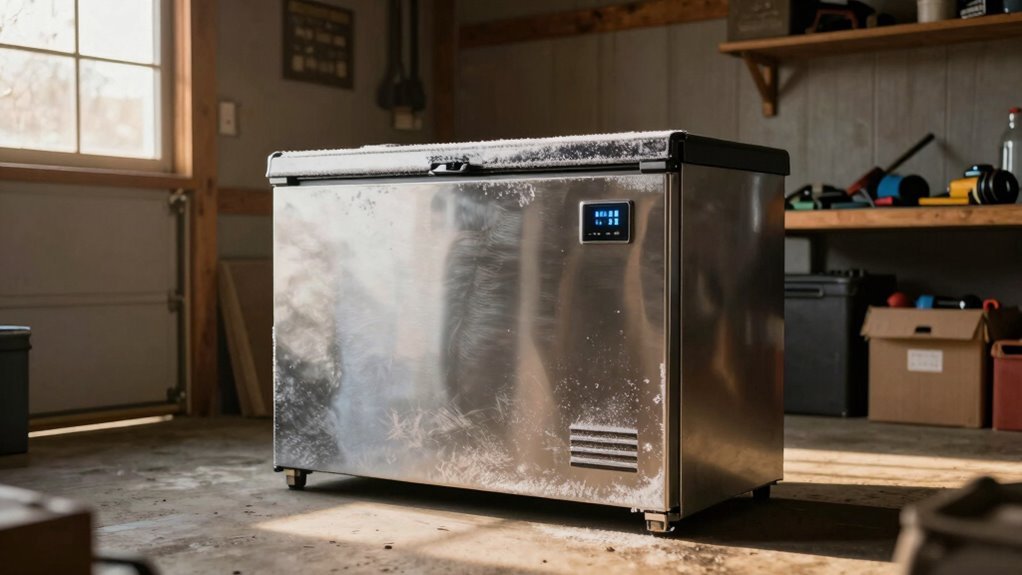
I check the capacity and footprint first to ensure the unit fits my available space. Next, I verify the temperature range limits and defrosting mechanisms so it handles extreme garage conditions. Finally, I compare energy efficiency ratings and door configurations to find the best match for my needs.
Capacity And Footprint
How much space do you really need? I always check capacity first. Most units range from 7 to 11 cubic feet. This number dictates exactly how much food you store. Next, I measure the footprint. Depths hit 25 inches, while widths stretch to 37 inches. Heights vary wildly from 32 to 66 inches. You must ensure it fits your garage layout. Upright models offer easier access and better organization for daily items. Chest freezers hold more volume but sit lower to the ground. Convertible units add versatility by mixing fridge and freezer zones. However, they demand careful planning for both functions. Flush-back designs work best in tight spots. They balance door swing and airflow needs perfectly. Don’t guess on dimensions. Measure twice before buying any unit. Your garage space is limited, so choose wisely now.
Temperature Range Limits
Once you’ve measured the space, you need to check if the unit handles your garage’s heat and cold. I always look for the specific temperature range listed by the manufacturer. Typical freezers hold between -10°F and 0°F, but some reach -20°F for long storage. If you buy a convertible model, pay close attention to which mode it is in. The ranges differ markedly between refrigerator and freezer settings. External thermostats are common here, and they control how precisely the unit maintains its internal climate. Stability depends heavily on your local weather. Many units specify an operating ambient range, like 0–110°F, to guarantee performance. If your garage gets hotter or colder than those limits, the food might spoil. You must match the machine’s capabilities to your actual environment to ensure everything stays frozen solid year-round without fail.
Defrosting Mechanisms
Why do you want to deal with ice buildup? I certainly don’t. Chest freezers usually need manual defrosting, so you must unplug them and drain water often. Upright models might offer frost-free options, but manual ones have simpler mechanics. You should check for built-in drains to make removing melted ice easier. Some units even include indicators telling you when defrosting is due. While manual systems save electricity compared to frost-free heaters and fans, they demand more work from you. Frost-free models run automatically but consume more power overall. You must decide if you prefer saving energy with extra labor or paying slightly more for convenience. Thick ice reduces storage space and hurts performance. Choose the mechanism that fits your willingness to maintain the unit in your garage.
Energy Efficiency Ratings
Where does your money go when the freezer runs all year? I check the annual kilowatt-hour rating first. Lower kWh means better efficiency for that specific size. Some labels show a daily cost estimate too. At twelve cents per kWh, you might pay roughly five cents daily. But remember, bigger units aren’t always more efficient than smaller ones. Insulation and temperature settings change everything. If you pick a convertible model, your energy use shifts when you switch between fridge and freezer modes. Garage conditions matter most here. Extreme heat or cold outside forces the compressor to work harder, hurting efficiency. You need a unit built for stable performance across wide ambient temperatures. Don’t just look at the sticker price. Calculate long-term running costs based on your local rates and garage climate before buying.
Door Configuration Options
Efficiency ratings tell you about running costs, but door style decides how you actually use the unit. I look at upright models first because they offer single or double doors with right or left swings. You can often reverse these hinges, which helps me fit the freezer into tight garage corners. Chest freezers work differently since they use top-opening lids. These units stay shorter but dig deeper inside, so I must reach down to grab items. While uprights use shelves, chest models rely on baskets that slide out. Some convertible units even switch between fridge and freezer modes, changing how I access food. I choose based on my space limits and how often I dig for frozen goods. The right configuration saves me from struggling every time I need ice cream or meat.
Interior Organization Features
I check the inside layout before buying because it decides how easy it is to find my food. Drawer or basket organization helps me separate items quickly. This cuts down on rummaging and bending over constantly. I look for clear compartments too since they let me see contents at a glance. Managing inventory becomes simple when I spot everything instantly. Removable baskets matter most to me because they allow custom layouts. I can fit bulky trays or large meat cuts easily this way. Top-open chest freezers often use these wire shelves to maximize space while keeping things accessible. Adjustable thermostats help too, as they support multiple storage zones. I organize items by their specific temperature needs and size. You should prioritize these features if you want a functional garage freezer that actually works for your daily routine without frustration.